


🎨 How to create your first comic in 2026: a complete guide
Comics have long outgrown the bounds of a childhood hobby. In 2026, this is a full-fledged creative industry with multibillion-dollar revenue, digital platforms, and a growing audience worldwide. The history of comics spans more than a hundred years, but it is the last decade that turned them into a global cultural and economic phenomenon. Creating your own comic opens the door to self-expression, professional growth, and steady income, and you can start with minimal investment: a pencil, paper, and an idea. In this guide, we will walk through the entire journey: from the first sketch to publishing and monetizing the finished work.
How to create your first comic: a step-by-step guide for 2026
💡 Quick overview:
- Step 1: Come up with an idea and define the genre: superhero, manga, webtoon, slice of life, or an original graphic novel.
- Step 2: Develop the characters: appearance, personality, motivation, and the development arc of each hero.
- Step 3: Write a script broken down into panels, with dialogue, action, and visual directions for each frame.
- Step 4: Create a storyboard, rough page sketches, panel layout, and narrative pacing.
- Step 5: Draw the final pages: line art, color, shading, and lettering (text in "bubbles").
- Step 6: Publish the work on a dedicated platform and launch promotion on social media.
The first step is always the hardest. According to observations by the authors of How to Draw Comics Academy, many beginners put off starting for months because they lack confidence in their artistic skills. Meanwhile, practice shows that working regularly, even for just 30 minutes a day, produces visible progress within 4 to 6 weeks. The main thing at the start is not to chase perfection. A first comic almost never becomes a masterpiece, and that is normal. Mistakes at the early stage teach you faster than passively studying theory. Make a test page of 4 to 6 panels with a simple everyday scene: it removes the psychological barrier and gives you a real sense of how frame layout works.
Tools and software: from traditional materials to digital technology
A modern comic artist is not tied to a single set of tools. The choice depends on budget, style, and publication format. Below is a comparison of the three main approaches.
Approach | Tools | Pros | Cons | Estimated budget |
|---|---|---|---|---|
Traditional | Paper, pencils, fineliners, markers, watercolor | Full tactile control, unique texture, no equipment required | Harder to make edits, cost of supplies | From $20 to $200 to start |
Digital (tablet) | Wacom, Huion, iPad Pro + Procreate | Fast edits, layers, export in any format | Takes time to get used to the "glass", device cost | From $300 to $2500 |
Hybrid | Sketches on paper, final line art and color on a tablet | Best of both worlds, flexibility at every stage | Double work for digitizing | From $50 to $500 |
A free YouTube course (3.5 hours) covers the entire process of creating a comic digitally: from shape design and rendering to the final page. It works for complete beginners; the author explains every Photoshop tool while building a finished project along the way.
The choice of software has expanded as well. Besides the industry standard Adobe Photoshop, Krita is gaining popularity, a free open-source editor tailored for comic artists. According to Krita community data, the program has been downloaded more than 5 million times, and its built-in panel templates and comic brush library cut page preparation time by roughly 30% compared with general-purpose editors. Another option is Clip Studio Paint, used by both hobbyists and professional manga artists: it has specialized tools for lettering, shading, and exporting to the infinite-scroll webtoon format.

You can start with the simplest thing: a sheet of paper and a pencil. The main thing is not the tool, but consistency. Rachel Smythe, the author of the webtoon "Lore Olympus," started with sketches in an ordinary sketchbook before her work became the most-read comic on the Webtoon platform with an audience of over 6 million subscribers.
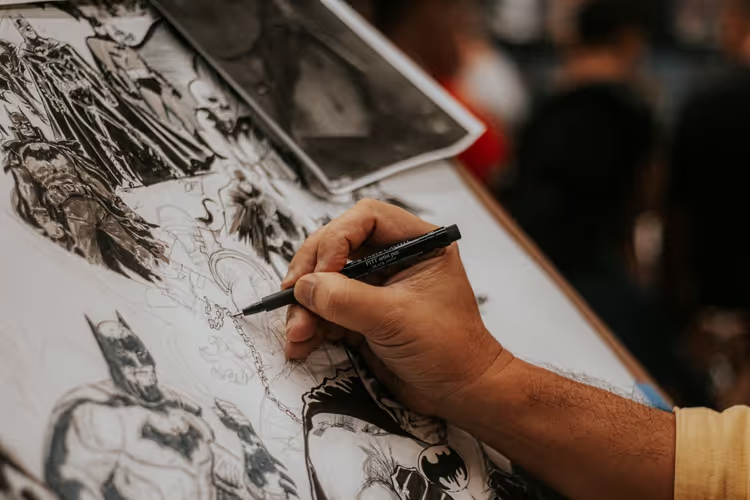
Traditional materials should not be written off even in the digital age. Many professional artists use a mixed technique: a pencil sketch on paper, then scanning and final linework with color on a tablet. Paper gives a special tactile feel and freedom that the glass surface of a screen does not always convey. Besides, a notebook and pencil work without charging, in any conditions, and with zero barrier to entry, an ideal tool for the first steps.
The global comics market: numbers that convince
The comics industry is experiencing steady growth, backed by figures from independent sources. According to a Fortune Business Insights report (May 2026), the global comics market was valued at $17.69 billion in 2025 and is projected to reach $18.63 billion in 2026, with a compound annual growth rate (CAGR) of 4.75%. By 2034, the market volume could exceed $27 billion. The Asia-Pacific region holds the lead with a 53.25% share. For context: the Encyclopedia Britannica notes that the modern comics market is comparable in volume to the film industry of a decade ago.
A more conservative estimate from Grand View Research puts the figure at $19.05 billion for 2025, with growth prospects to $37.15 billion by 2033 (CAGR 8.9%). The spread in estimates is explained by different methodologies, but both sources agree on the main point: the market is expanding, and the digital segment is the driver.
Market segment | 2025 volume | 2026 forecast | CAGR | Source |
|---|---|---|---|---|
Comics (overall) | $17.69 billion | $18.63 billion | 4.75% | Fortune Business Insights, May 2026 |
Webtoons | $10.75 billion | $14.02 billion | 30.5% | The Business Research Company, 2026 |
Digital comics (subscriptions) | $4.8 billion | n/a | ~23% | Data Insights Market, 2025 |
The most impressive momentum is in the webtoon segment: The Business Research Company recorded growth from $10.75 billion in 2025 to $14.02 billion in 2026, a CAGR of 30.5%. The webtoon as a format, vertical infinite scrolling optimized for smartphones, attracts an audience that previously never read comics at all: according to Webtoon's internal statistics, about 40% of the platform's users are women aged 18 to 34, a demographic traditionally far removed from classic comic shops.
Where to publish and how to make money from comics
Previously, a comic creator was tied to a publisher. Today the barrier to entry is practically nonexistent: you just need to register on one of the platforms and upload your first chapter. Let's look at the main options.
Webtoon Canvas, the largest platform with free publishing. In early 2026, Webtoon updated its monetization terms: the payout threshold via PayPal was lowered and the Ad Revenue Sharing program was expanded. In practice, this means that creators with a sufficient audience (40 thousand monthly views and 1 thousand subscribers) can receive regular payouts. According to publicly available creator data, average income ranges from $0.50 per thousand page views, meaning an author with 200 thousand monthly views can expect roughly $100 a month from ads alone, not counting donations and Patreon.
Tapas, an alternative focused on indie creators and a donation-based model. The platform lets readers "support" their favorite authors directly (Tips) and also enables Ad Revenue once an audience is built.
Direct sales and crowdfunding. Many creators combine platforms with their own channels: print runs through Kickstarter (comic campaigns regularly raise anywhere from a few thousand to tens of thousands of dollars), digital copies through Gumroad, and merchandising (t-shirts, prints, sticker packs).
A real example: Ingrid Ochoa, the creator of the webtoon "The Kiss Bet," started publishing on Webtoon Canvas in 2020 with no budget and no team. By 2025, her work had surpassed 300 million views, became a Webtoon Original with a regular fee, and is being prepared for print publication. This is not an exception: according to Webtoon statistics, about 500 Canvas creators have moved to Originals with a contract over the past three years.
⁉️🤔 Frequently asked questions
Do you need to know how to draw to create comics?
A beginner level of drawing is enough. Far more important is the ability to tell a story: storyboarding, pacing, dialogue. Many successful webtoons, including "The Adventures of Dr. McNinja" and "XKCD," are built on a minimalist style and are valued for their writing and humor rather than detail. If drawing is really not your thing, you can work in collaboration: a writer plus an artist is a standard model in the industry.
How long does it take to create one comic chapter?
For a webtoon of 40-60 panels (a standard episode): 20 to 60 hours of work, depending on style, experience, and whether you have assistants. Professional Webtoon Originals creators deliver an episode per week, working full-time with a team of 2-4 people. A Canvas beginner can release an episode every 2-4 weeks in their spare time, and that schedule is considered normal for starting out.
How much does it cost to publish a comic in print?
Printing a small run (color comic, softcover) costs a few hundred dollars depending on the number of pages and copies. A black-and-white version is noticeably cheaper. Digital publishing (PDF via Gumroad) is free or costs a small platform commission on sales. On Kickstarter, comic campaigns regularly raise anywhere from a few thousand to tens of thousands of dollars depending on audience size and presentation quality.
Which comic genres are most in demand right now?
According to Grand View Research data, the manga segment holds about 38% of the global market, superheroes roughly 25%, and the slice of life/romance genre is the fastest-growing in webtoon format (annual growth of about 18%). The takeaway: there is demand for any genre, the key is a unique authorial voice.
Can you make money from comics if you don't live in the US or Korea?
Yes. Webtoon and Tapas operate globally and pay out via PayPal in most countries. The language barrier is shrinking: Webtoon accepts work in 10 languages, including a Russian section. Russian-speaking creators, such as the "Tiger's Bride" team, have successfully raised tens of thousands of dollars through crowdfunding for comic printing, targeting an international audience with an English translation.
Should you sign an exclusive contract with a platform?
An exclusive deal (for example, Webtoon Originals) provides a stable monthly payment and promotional support, but restricts your rights: you cannot publish the same comic on other platforms. A non-exclusive model (Canvas, Tapas, GlobalComix) keeps all rights with you and lets you diversify income through Patreon, merch, and direct sales. The optimal strategy for a beginner: start non-exclusively, build an audience, and then evaluate platform offers.
Summary: your first comic is closer than you think
Creating a comic in 2026 is not a closed club for a select group of artists. The tools have become more accessible, platforms are looking for new creators, and the market is showing double-digit growth rates in the digital segment. Our experience working with beginning creators confirms: the main barrier is not a lack of talent or expensive equipment, but putting off the first step. You don't need to wait for the perfect moment or a professional tablet: a pencil, a sheet of paper, and one good idea, that's all that separates you from the first page.
Start with a short story of 8-12 panels. Upload it to Webtoon Canvas or Tapas. Get your first feedback. And when you feel confident, expand your toolkit, grow your audience, and add monetization. A journey of a thousand panels begins with the first sketch. Pick up a pencil today.

A professional team of writers and editors specializing in creating quality content.