


📚 Book fairs for authors: how to choose a venue and make the trip pay off in 2026
A book fair looks like a holiday for readers from the outside, but for an author it is an ordinary business trip with a budget, a schedule, and an expected result. Some of the tasks that bring people to the booth can be handled noticeably cheaper by other means: letters to publishers, outreach to agents, or through a guest posting marketplace, where a text about the book is placed on a niche platform without a single flight. Below we will look at how to match a fair to a specific goal, what is actually sold there, and what signs indicate that the trip paid off.
How to prepare for a fair without unnecessary spending
💡 Quick overview:
- Step 1: Define one main goal for the trip. Selling rights, finding an agent, meeting readers, and gathering material for the press require different venues and different behavior on site.
- Step 2: Choose a fair based on that goal, not on how big the name is. The largest venue is not always the most useful for a debut author.
- Step 3: Apply for a speaker slot or panel well in advance, several months before the event: the program is put together long before the doors open.
- Step 4: Put together a materials package: a short description of the book, territorial rights, an excerpt, contacts, and a link to the author page.
- Step 5: Book meetings on your calendar before you arrive. Spontaneous conversations at a booth almost never turn into deals.
- Step 6: Calculate the budget and set the threshold below which the trip counts as a failure.
- Step 7: Set aside a week after you return for emails, promised files, and posts about the trip.
The order of the steps matters more than their number. An author who comes "just to look around" usually returns with a bag of catalogs and not a single contact, because all the meeting slots with the people they needed were booked back in September. An author who picked ten publishers in advance and wrote to them before the opening gets the same ten conversations, only scheduled, short, and productive. The difference in cost is zero.
Five venues and five different tasks
Fairs are usually listed one after another, like a calendar, but they have far more differences than similarities. Some are set up as a rights exchange with meeting tables, others as a giant reader celebration with lines for autographs. Below are five key events of the coming season and the tasks each one suits best.
Venue | Upcoming dates | Most useful for |
|---|---|---|
Frankfurt Book Fair | October 2026 | selling rights, translations, finding a foreign publisher |
London Book Fair | March 16 to 18, 2027 | English-language market, literary agents |
Sharjah Book Fair | November 4 to 15, 2026 | Arab market, translation support programs |
Guadalajara Book Fair | November 28 to December 6, 2026 | Spanish-language market, direct contact with readers |
Bologna Children's Book Fair | April 5 to 8, 2027 | children's and young adult books, illustration |
The scale of these events differs by an order of magnitude, and strategy depends directly on scale. The final report from the Frankfurt organizers on the fall 2025 results records 238,000 visitors and about 4,350 exhibitors from 131 countries. Moreover, the distribution within that figure matters more than the figure itself: the facts and figures summary for the 77th fair clarifies that 118,000 people came with professional accreditation, and the rest on days open to the public. For an author, this means a simple thing: the first three days in Frankfurt are set aside for work, and the weekend for meeting readers, and they need to be planned differently.
London is more compact and therefore more convenient for targeted negotiations. The review of the 2026 London session results reports more than 33,000 visitors and 1,005 exhibitors over three days. The ratio of "few days, many industry professionals" makes this venue a logical choice for those looking for an agent in the English-language market. The move is worth noting: according to the official London Book Fair website, the 2027 event will be hosted by the Excel exhibition center in east London, meaning the usual logistics with hotels near the previous venue no longer work.
The Middle Eastern and Latin American venues follow a completely different logic. The closing report for the 44th Sharjah Book Fair reports 1,400,730 visitors from 206 countries and 2,350 participants from 118 countries over twelve days. The publication on the Guadalajara Book Fair results describes record figures for the venue: more than 950,000 visitors, 18,400 industry professionals, and 165 literary agents. Such numbers mean a giant reader funnel, but also high noise: getting through to the right person there is harder than in London, but the reach is incomparable.
Bologna stands apart as a narrowly specialized event. The 2026 children's book fair program overview describes a venue where children's and YA publishers gather at nearly full strength, and the flow of professional visitors holds at the level of previous seasons despite difficulties with international travel. The dates for the next season are published on the official Bologna fair website. For a children's book author or illustrator, this venue is more valuable than any general-interest fair: over four days, nearly everyone who makes decisions in the segment gathers there.
A speaking slot as an underrated asset
Organizers of almost any fair need speakers, and this is the least expensive way to turn passive attendance into a reason for conversation. A talk changes your status: people approach the person who just led a session on their own, and your name appears in the program, which journalists and book reviewers later read. The application, however, is submitted well in advance, because the schedule of panels, signing sessions, and workshops is put together months before opening.
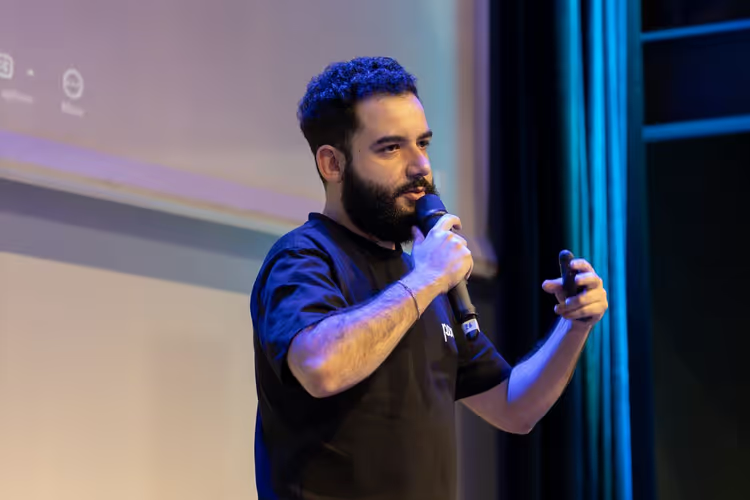
A good proposal almost never sounds like "I'll talk about my book." It is framed as a benefit to the audience: a craft breakdown, experience working with an editor, how a niche works, mistakes made when entering a foreign market. The book's subject stays in the background and comes up naturally. A practical tip: propose not one topic but three, at different levels of generality. The program committee assembles a mosaic from dozens of proposals, and variety sharply increases your chances of filling a gap in the schedule.
The separate value of a talk begins after it ends. Mentioning the panel is appropriate in a bio, in a press release, in a letter to a potential publisher, and on the author's page. For reviewers and editors, it signals that professional venues have already worked with this author, which means lower risk. Individually, such details weigh almost nothing, but together they determine who gets written about and who does not.
Rights and translations: where the deals actually happen
The main product at a major international fair is not a book, but a license. People buy and sell translation rights, audio rights, film rights, and the right to publish in a specific territory. That is why the rights centers are booked long before opening day and run on a strict schedule of half-hour slots. The author's guide to how Frankfurt works explains this mechanics in detail, and its main takeaway is sobering for newcomers: an author rarely sells rights directly; it is usually done by an agent or the publisher's rights department.

The scale of this parallel fair within the fair is easy to see from the numbers. Frankfurt's official statistics note that the literary agents center hosted 321 agencies from 32 countries and was completely sold out. You cannot just walk in from the street; tables are booked months in advance. That means an independent author has two realistic options: either arrive with meetings already arranged outside the rights center, or use the fair as reconnaissance and build a list of people to contact over the next six months.
A separate breakdown of what exactly is sold and in what form is provided by materials on selling rights at fairs for independent authors. The main self-publishing mistake is stated there bluntly: showing up with a finished book and no territory-by-territory list of available rights. A partner needs to understand within a minute what exactly is free, in which languages, for how long, and who signs the contract. If there is no answer, the conversation ends with a polite "we'll get back to you later."
A real case: what guest of honor status delivers
The clearest example of how fair mechanics work is the guest of honor program. A report on the results of Frankfurt 2025 describes how a guest country gets not just a separate stand, but a full program: a pavilion, a series of author events, a dedicated line of programming, and press attention throughout the event. That year the guest was the Philippines, and for their authors it meant access to an audience that no individual effort could ever assemble.
The same logic applies to the children's segment. The program for Scandinavian participation in Bologna 2026 was built around a delegation of authors and illustrators, not around a display of books. The takeaway for an individual author is direct: if your country, region, publisher, or professional association is bringing a collective stand, getting into its program is almost always cheaper and more effective than going alone. The collective stand has already paid for the space, is already on the floor plan, and already draws visitor traffic.
How to calculate the return on a trip
A fair does not pay for itself through book sales at the stand, and you should not expect that. The return is measured in other terms: the number of scheduled conversations, the number of manuscripts requested, inclusion in press roundups, invitations received. It helps to write down in advance what result you will consider a success, because after four days on your feet, any trip in hindsight feels like either a triumph or a failure, and both conclusions are equally useless.
Expense item | What affects the amount | How to reduce it |
|---|---|---|
Accreditation | ticket type, early registration | buy in the first sales wave |
Travel and lodging | distance from the venue | stay in a nearby area with transit access |
Stand or share in a collective stand | participation format | enter through a collective stand |
Printed materials | print run and quality | small print run plus a digital version |
Days without meetings | quality of preparation | a dense calendar scheduled in advance |
The biggest hidden item in this table is the last one. An empty day at a fair costs exactly the same as a full one, but produces nothing. That is why experienced participants arrive with a schedule where every hour has a purpose, including time for lunch and moving between halls. If the calendar is empty, it is cheaper to cut the trip by a day than to fill it with wandering through the pavilions.
What to do in the first week after you return
Most of the result is created not at the venue, but right after. Promised files go out within two business days, while the other person still remembers the conversation. The email should include a reminder of the meeting context, because that person held dozens of negotiations over four days and is not obligated to remember yours specifically. It helps to attach what you agreed on right away, rather than promising to send it later.

The second layer of work is the public footprint of the trip. A short breakdown of what you saw, notes on segment trends, observations about what was being bought and what people asked about at panels get read more eagerly than a report on your own successes. Such material makes the trip visible to those who were not there, and also justifies the next one: editors and partners find it easier to work with an author who can talk about the market, not only about themselves.
The third step is the most boring and the most valuable. Consolidate your contacts into one list with notes on who does what and what you discussed, and set a reminder for the fall. Some conversations started at a stand reach a result a year later, and without notes that part simply gets lost.
⁉️🤔 Frequent questions
Is it worth going to an international fair without a published book?
You can go, but the goal is different then. Without a finished manuscript and without rights broken down by territory, license negotiations are pointless. But reconnaissance works: you will understand the market structure, build a list of publishers in your segment, and get contacts for follow-up correspondence. Such a trip makes sense to keep short and cheap.
Which venue is better for a debut author?
Usually not the biggest one, but the most specialized one. A children's book author gets more out of Bologna than Frankfurt, because there the whole hall is full of the right people. At giant general-purpose venues, a debut author most often gets lost in the flow and leaves without any scheduled conversations.
Do I need my own stand?
In the vast majority of cases, no. An individual stand makes sense for a publisher with a catalog, not for an author with one or two books. A sensible alternative is joining a collective stand of a region, association, or publisher, where the space is already paid for and there is visitor traffic.
How do I get a spot on a panel or workshop?
Apply well in advance and frame it as a benefit for the audience, not as a book presentation. Offer several topics at different levels of generality, point out what exactly makes your experience different from others, and include a link to any previous speaking engagement, even a local one.
Are books actually sold at the fair?
At reader-oriented venues like Sharjah and Guadalajara, retail sales do happen; at professional ones like Frankfurt, mostly on days open to the public. But you should not count on recovering costs through retail: a fair pays off through contacts, rights, and subsequent publications.
Summary
Choosing a fair is not a matter of prestige, but of matching the venue to the task. Frankfurt and London work for rights and agents, Sharjah and Guadalajara provide a giant reader funnel, Bologna covers the children's segment entirely. Within any of them, the result is determined by three things: meetings scheduled in advance, a clear package of materials with rights broken down by territory, and discipline in the first week after you return.
Start small: take the nearest event on the calendar from the table above, write down one main goal for the trip, and make a list of ten specific people or organizations you want to talk to. If that list does not come together, postpone the trip and spend the season on correspondence and publications, then go to the venue with agreements already in place.

A professional team of writers and editors specializing in creating quality content.