



📚 Book market trends 2026: what is changing for independent authors
Forecasts a year ahead usually become outdated faster than the next book comes out, so in this piece we are not talking about predictions, but about shifts that are already confirmed by industry statistics. We will also look at why some independent authors are increasing their visibility through a platform for guest posts rather than only through storefronts, and what that gives them as search traffic declines.
How to rebuild your author strategy for the new market
💡 Quick overview:
- Step 1: Pin down where your readers actually come from today: store, newsletter, social media, search, offline. Write down the percentages instead of relying on impressions.
- Step 2: Open your own storefront for direct sales, even if the first few months bring only token volume.
- Step 3: Convert at least one title to audio and compare its revenue with the ebook version over the same period.
- Step 4: Rewrite your book descriptions so a machine can extract a fact from them, not an advertising phrase.
- Step 5: Build a list of readers you can reach without intermediaries, and grow it every month.
- Step 6: Plan one experiment per quarter: crowdfunding, translation, a live stream, or an event at a local bookstore.
These six points are not about chasing technology trends. They are about a change in the load-bearing structure: authors used to build their business around someone else's storefront and someone else's search traffic, and now both supports have become noticeably less reliable. Below we will break down each area separately, with numbers and caveats.
Direct sales are moving out of experimental status
A few years ago, having your own store looked like a hobby for perfectionists: a lot of hassle, negligible revenue. Now the logic has flipped. A direct sale gives an author three things no marketplace can offer: the buyer's contact information, the full margin, and freedom in how the offer is packaged. That is exactly why special editions, bundles, and subscriptions have migrated to authors' own storefronts and crowdfunding platforms.
The scale is visible in crowdfunding. According to an Indie Author Magazine breakdown, the Kickstarter publishing category has raised more than $380 million across more than 69,000 launched projects, and growth is happening across every metric at once: number of campaigns, number of first-timers, amounts raised, and the share of successful campaigns. These are no longer isolated stories, but a working preorder channel.
The difference in results is telling as well. Campaign success statistics show a 56% success rate in the publishing category overall, while authors who prepared their campaigns inside an organized community reached 90% or higher. The gap comes down not to budget, but to audience building before launch. Individual examples of joint campaigns confirm the upper range: a dystopian romance anthology from a group of authors brought in more than $1.4 million. Among high-profile solo cases, Brandon Sanderson is the one most often cited, with a campaign that raised $16 million according to a Publishers Weekly article.
Channel | What it gives the author | What it requires | A sensible first step |
|---|---|---|---|
Marketplace | Traffic and platform trust | Commission, no buyer contact | Keep as a base, but not as your only support |
Your own storefront | Full margin, buyer data | Your own logistics and support | Sell one bundle or subscription |
Crowdfunding | Money before printing, demand validation | A ready audience at launch | A campaign for a special edition of an already published book |
Offline events | Live contact, high average order value | Time and physical copies | One fair or meetup per quarter |

Search is no longer a free channel for readers
The most unpleasant change concerns not books, but how readers get to them. Search results have turned into a ready-made answer, and clicking a link has become optional. According to SparkToro research based on Similarweb panel data, in the first four months of 2026, 68.01% of US search queries ended without a single click to a website, compared with 60.45% two years earlier. For comparison, the same calculations recorded 49% in 2019. In other words, over a decade, free search traffic has shrunk by roughly half in terms of return.
Industry reviews from Search Engine Land describe the same picture from the publisher side: pages continue to rank, but they bring fewer and fewer clicks. For an author, this means a simple thing. A blog with book reviews or craft advice can no longer be considered a standalone source of sales; it works as a place where trust is built, and you have to bring traffic to it yourself.
The practical takeaway is not to abandon writing, but to change its purpose. Material should contain specifics that cannot be summarized in one line: personal numbers, process breakdowns, interviews, mistakes. Such text will either be quoted with attribution, or the reader will have to visit the page. That is exactly why guest posts on other platforms have become meaningful again: they bring a real person from someone else's audience, bypassing search results.
Audio is growing, but synthetic voice is still on the sidelines
Audio remains the healthiest segment of the market. According to Audio Publishers Association data, audiobook sales in the US reached $2.43 billion in 2025, up 9% from the previous year. The Bookseller describes the five-year trend as roughly 80% growth in digital audio over five years, which looks almost anomalous for a mature industry.
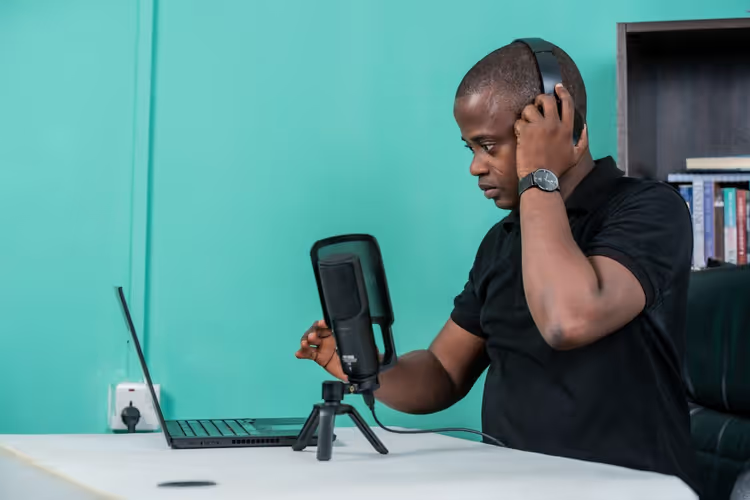
The catalog is expanding even faster than the audience. An APA survey of active titles counted over 750,000 available audiobooks, 43% more than a year earlier. Such a jump is only possible when production gets cheaper, and machine narration plays a key role here. At the same time, the same organization's audience reach data notes that 58% of American adults, about 157 million people, have listened to an audiobook at least once.
Then comes the less obvious part. Synthetic voice sharply increased the number of titles but barely increased revenue: APA’s estimate for artificial voices shows that only 16% of listeners have ever tried such an audiobook, and the share of those sales in total revenue in 2025 remained within hundredths of a percent. The practical takeaway for an author: machine narration works for nonfiction, reference books, and the back catalog, but a flagship novel is still worth giving to a human narrator.
A format that deserves separate attention is one conceived as audio from the start. APA data on audio-first releases shows revenue for such titles growing from $91.1 million to $136 million, roughly one and a half times in a year. This is a niche where an independent author competes not on print runs but on speed and voice.
Translation is no longer a privilege of big names
Not long ago, entering a second language meant a five-figure bill and six months of waiting. Machine translation followed by editing from a native speaker has cut both the cost and the timeline so much that the decision moved from the investment category to the experiment category. The logic is the same as with audio: technology lowers the barrier to entry but does not remove the need for quality on the output side.
A sensible approach looks like this. Take a book with proven demand in its native language, not a new release. The machine produces a draft, a native-speaking editor cleans up tone, names, and cultural references. Then you test not an abstract market but a specific store: does it carry your genre, how much does a comparable book cost, who promotes it. If sales in the test language don’t pick up within a quarter, the mistake is almost always in the choice of language or the cover, not in the translation itself.
An important caveat: the market will quickly learn to tell a polished translation from a raw one. Readers forgive rough style, but they don’t forgive the feeling that the book was pushed through a conveyor belt and never opened. So the line item for a native-speaking editor is not up for cuts.
Video, live streams, and the price of human presence
Video generation has become nearly free, and that has undercut video itself as an argument. When anyone can assemble a clip in ten minutes, value shifts to what is hard to fake: an unedited stream, a live reaction to a question, showing the process without cuts. Hence the counter-trend toward live broadcasts with sales happening right on air.
For an author, this does not mean you have to become a host. One regular format is enough, one where you are visible without a script: answering reader questions, reading a fragment, working on a revision in real time. A stream like that solves a problem no algorithm can solve: it confirms that a real person stands behind the book, not a generator.
A thousand true readers instead of a million random ones
All the previous points converge at one place. A store can change its terms, search can stop delivering clicks, a social network can collapse your reach overnight. The only asset an author keeps in any scenario is the list of people you can write to directly.

A real example fits here, not a hypothesis. The campaigns mentioned above are structured the same way: money is raised not from a cold platform audience, but from people who have already read the author and were waiting for the next book. That is exactly why prepared communities show a success rate noticeably higher than the category average, and record sums go to those who spent years building an email list and a podcast before their first campaign. Crowdfunding does not create an audience; it cashes one in.
You can check the state of your own asset in one evening. Count how many people you can tell about a book release without an intermediary, and what share of them opened your last email. If the second number is below a third, the problem is not the size of the list, but that you only reach out to it on sales days.
What to do about all this in practice
When assembling the full picture, it is worth remembering the main constraint: the market as a whole is growing slowly. According to the AAP StatShot annual report for 2025, total US book industry revenue reached $33.4 billion, while the consumer segment added 2.7% and hit $21.7 billion. At the same time, AAP estimates by format show that print still accounts for 76.3% of consumer revenue, while digital formats hold about 21.5%.
This means none of the shifts described above cancels the basic work. Print books have not gone anywhere, ebooks are growing modestly, audio is growing faster than the rest. The winner is not the one who rushes into a new format first, but the one who adds one channel to a working foundation and gets it to pay for itself before taking on the next.
⁉️🤔 Frequent questions
Should you leave a marketplace for your own store?
No, it is smarter to keep both channels. A marketplace brings outside traffic and platform trust; your own storefront returns margin and customer contacts. Practice shows that direct sales start to noticeably affect income only after an author has their own reader list, so a store is opened in parallel, not instead of the familiar storefront.
Is it true that search traffic is dead for author blogs?
Not dead, but devalued as the only source. According to SparkToro estimates, most queries today end without a click to a website. A blog is still useful as a place where a reader confirms your competence, but you have to bring people there through email, guest posts, and mentions from colleagues.
Can you voice books with a machine voice without losing reputation?
For nonfiction, reference books, and the back catalog, this is a workable solution. For literary fiction, the risk is higher: the share of listeners who have even tried synthetic narration remains small according to Audio Publishers Association estimates, and revenue from such editions is still barely visible against the market. A reasonable compromise is a human narrator for flagship books and a machine for the long tail.
Which language should you start translating into?
The one where your genre already has a visible shelf in the local store and a clear price range, not the one where there are simply a lot of people. Test one book with proven sales at home, always with editing by a native speaker, and evaluate the result over a quarter, not a month.
How long does it take to prepare a crowdfunding campaign?
The page itself comes together in a couple of weeks, but the audience takes months to prepare. The difference in results between standalone campaigns and campaigns inside a community, which Indie Author Magazine writes about, is explained precisely by the preliminary work: announcements, a waiting list, and a clear reason for the reader to pay in advance.
What if you only have energy for one direction?
Choose the reader list. It strengthens all other channels at once: without it, neither crowdfunding, nor direct sales, nor a launch in a new language works. Everything else can be added one experiment per quarter, calmly checking whether the new channel pays off.
Summary
The year did not bring a revolution to the book market; it brought redistribution. The storefront remained, but stopped being the only one. Search remained, but stopped being generous. Technology made narration and translation cheaper, but did not cancel editing. Audio is growing faster than other formats, while print still holds most of consumer revenue.
If you have read this far, pick exactly one step from the overview at the start of this piece and do it this week: count your reader sources, open a storefront, order a test narration, or write your first guest post. One experiment carried through to the end gives you more than a dozen open tabs with forecasts. Read other breakdowns of publishing practice on the blog and come back to this list in a quarter to check which of it has already become your routine.

A professional team of writers and editors specializing in creating quality content.