


📜 Documentary writing: the art of truth
Documentary writing: how to tell the truth so people actually read it
Documentary writing is the art of turning verified facts into a story you cannot put down. Unlike fiction, the author here is bound by the truth: every scene, figure, and line of dialogue must hold up under scrutiny. And demand for this kind of honest prose is growing. According to The Business Research Company, the global nonfiction market was valued at $15.41 billion in 2025 and is expected to reach $15.85 billion in 2026. Readers want real stories, and the author's job is to make a fact sound like a plot without losing accuracy.
💡 Quick overview: documentary writing rests on three pillars: credibility, research, and narrative craft. Below we walk through the entire path from choosing a topic to publication, step by step.
- Verify every fact against at least two independent sources.
- Structure your text using the inverted pyramid: the most important information comes first.
- Combine journalistic accuracy with the techniques of fiction.
- Prepare your manuscript for fact-checking as if a meticulous editor will read it.
In this article I will break down the whole process the way I go through it myself when working on documentary material: from the first question of "what is this even about" to the final read-through. Each section ends with a practical technique you can apply to your own text today.
What documentary writing is and why it is harder than fiction
Documentary writing is a genre in which the author works only with real events, facts, and people, without resorting to invention. It includes memoirs, investigative journalism, historical essays, biographies, and narrative nonfiction, which is what English-language authors call narrative nonfiction: a true story told using the techniques of a novel.
The paradox of the genre is that the author's freedom here is severely limited. A novelist can invent a dialogue, while a documentary writer must reconstruct it from recordings or interviews. This discipline is the main challenge. As Brown University notes, popular nonfiction generally does not undergo mandatory editorial fact-checking before publication, which means the responsibility for accuracy falls entirely on the author. There is no built-in safety net: if you make a mistake, you answer for it.
This sets documentary writing apart from fiction more than it seems at first glance. A novelist answers only to the internal logic of their own invention. A documentary writer answers to the real people whose actions they describe, to the reader who believes every word, and often to the law, when living people are involved. That is why the craft begins not with style, but with ethics.
Three principles hold the entire genre together:
- Credibility. Every claim rests on a source you can produce.
- Objectivity. The author's opinion does not replace the fact; the reader draws their own conclusions.
- Honesty of presentation. Drama does not justify distortion: you cannot bend the truth to fit the plot.
How to choose a topic that will go the distance
A documentary topic is a commitment for months, sometimes years. So the choice is not made on the basis of "what is trendy," but on the basis of "what will not let you go." Ask yourself: why should I be the one to tell this particular story? Do I have access to the people, documents, and places involved? Will I have the stamina to return to the material six months from now?
A strong topic usually meets three conditions at once. It is relevant, meaning it resonates with what concerns readers today. It is specific: it has a face, a place, and a time frame, not an abstract "societal problem." And it is provable, because you can actually gather the material rather than hitting a wall of closed archives and silent witnesses.
Demand for honest stories is confirmed by reading data. According to Pew Research Center, 75% of American adults read at least part of one book in the past year, and nonfiction segments such as memoirs, history, and true crime are steadily gaining popularity. According to NielsenIQ, nonfiction showed revenue growth in 8 of the 19 countries analyzed in 2025, meaning there is an audience for quality documentary prose, but the competition for it has intensified. This means a well-told real story finds its reader, if the author has done the work to bring it to completion.
Research: the foundation without which the text collapses
If choosing a topic is the idea, then research is the material from which the building is constructed. Narrative nonfiction requires especially deep preparation: the author needs to understand the motives and circumstances of the people involved from every angle before turning them into scenes.
Four main types of source material are used:
- Interviews. Conversations with participants in the events provide details and perspectives that do not exist in documents. Record them and keep the originals.
- Archives. Old letters, records, photographs, and newspapers recreate the atmosphere of the era and establish the facts.
- Fieldwork. Visiting the locations and observing firsthand gives you sensory details that bring the text to life.
- Published sources. Books, academic articles, and reports show how the event has already been interpreted before you.
The key rule: cross-verification. As The New School Library recommends, any claim should be confirmed by several independent sources, because agreement among data from different places is the mark of reliability. One source is a version; three that agree are a fact. In practice, I create a separate source table for each project: what is claimed, who said it, where it can be rechecked, and when I consulted the material. Such a table saves days at the fact-checking stage.

Fact-checking: why it is no longer an intern's job
Ten years ago, fact-checking in documentary projects was often handed to junior staff as an afterthought. Today the attitude has changed radically. In an environment where falsehood spreads instantly, accuracy has become not a "nice extra" but a condition for reputational survival.
The scale of the phenomenon is visible across the professional fact-checking industry. According to the State of the Fact-Checkers Report 2024 by Poynter / IFCN, the study covered 141 fact-checking organizations from 67 countries. Nearly 80% of fact-checkers reported facing threats or harassment in 2024, and about 90% named financial sustainability as their main challenge, so verifying the truth has become physically and economically difficult. Around 50% of organizations already use AI for preliminary research, but the final decision remains with a human.
For a solo author, the practical takeaway is this: you have no in-house verification department, so build your own protocol. Documentary makers, as the International Documentary Association notes, increasingly embed fact-checking directly into the workflow rather than leaving it for the end. It is cheaper in terms of time and more reliable in terms of results, because fixing one scene is easier than reworking a finished manuscript.
Work stage | What we check | How we record it |
|---|---|---|
Gathering material | Reliability of every source | Link and access date |
Draft | Figures, names, dates, quotes | Footnote for every fact |
Editing | Agreement of data from different sources | At least two confirmations |
Final | Disputed claims | Flag or remove |
How to write so a fact sounds like a story
Accuracy alone will not hold a reader, because form matters too. Start with the inverted pyramid principle: the most important and most striking material goes first, and details and context unfold after that. The first paragraph is a hook, meaning an anecdote, an unexpected fact, or a question that makes the reader keep going.
After that, the techniques of literary fiction come into play, and they are allowed in documentary writing on one condition: nothing is invented. A detailed description of a real place, dialogue reconstructed from recordings, a character's internal logic rebuilt from interviews, all of this makes the text come alive. The line is simple: a technique serves the truth, it does not replace it.
A real example of how this works is Truman Capote's book In Cold Blood. The author spent six years gathering material, conducted hundreds of interviews with townspeople and the convicted men themselves, and built a narrative from documented facts with the tension of a detective novel. The book became a landmark of the genre precisely because every "novelistic" scene rested on verified testimony, not on the author's imagination. The same approach works in short form too: a ten-thousand-character feature benefits from a scene, dialogue, and a concrete detail exactly as much as a four-hundred-page book does.
To see specific narrative nonfiction techniques in action, watch this breakdown from a working author:
Editing and publication: the final stretch
Even experienced authors cannot see their own text from the outside. Find an editor or a colleague who will check the logic, clarity, and persuasiveness, and who will also catch the factual slips you have stopped noticing. A good editor for a documentary writer is a second fact-checker.
Once the text has been proofread and checked, several publication paths open up. You can publish a feature in a magazine or on a platform, release a series of pieces on a website, or gather everything into a book. Each format imposes its own requirements for length and presentation, but the requirement for accuracy stays unchanged. Personal experience is invaluable here: many strong documentary writers, as shown in the piece on how to assemble an anthology of your own work, include their own participation in events, and that is exactly what makes the prose convincing.
A documentary writer's tools
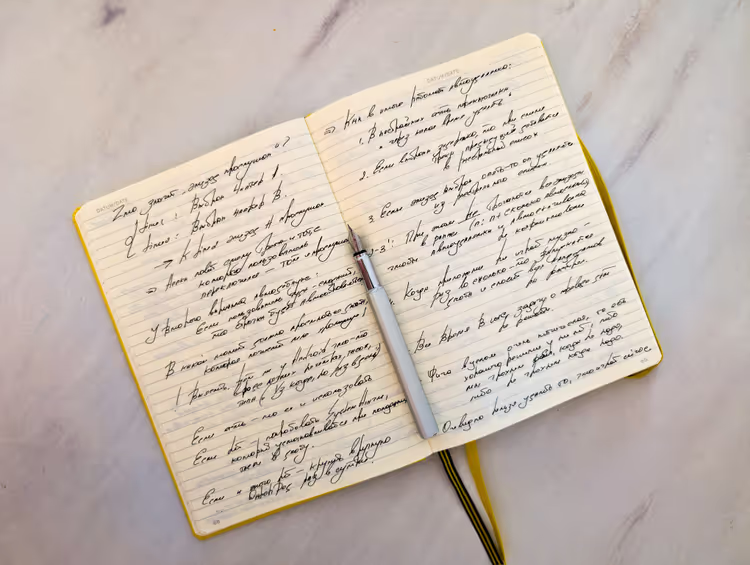
The right tools save weeks of work and protect you from losing material. The basic kit of a modern nonfiction author looks like this:
- A voice recorder or recording app to preserve interviews verbatim.
- A notes system (Notion, Obsidian, Google Docs) for structuring sources and drafts.
- A reference manager so every figure in the text leads to a verifiable source.
- Access to archives and libraries as the foundation of primary research.
- A camera for capturing locations and details.
Tool | Purpose | When it is critical |
|---|---|---|
Voice recorder | Recording interviews | During fieldwork |
Notes manager | Structuring material | With large volumes |
Reference manager | Linking facts to sources | During fact-checking |
Archive access | Primary documents | For historical topics |
⁉️🤔 Common questions about documentary writing
How is documentary writing different from journalism?
Journalism more often works with current news and short form, while documentary writing is a long narrative where facts are arranged into a full story with characters and an arc. Both genres require fact-checking, but a documentary writer pays more attention to literary form and depth of context.
Can you use literary techniques in a documentary text?
Yes, but with a strict limit: a technique must not produce invention. Descriptions, dialogue, and internal monologues are acceptable if they are reconstructed from real sources such as recordings, interviews, and documents. A scene invented for the sake of beauty turns nonfiction into fiction and undermines the reader's trust.
How many sources do you need to verify one fact?
The minimum reliable standard is two independent sources, and for disputed or important claims three is better. According to library fact-checking guides, agreement between data from different, unconnected sources is the main sign of a fact's reliability.
Who is responsible for errors in published nonfiction?
The author bears responsibility. As university nonfiction guides note, popular books usually do not undergo mandatory editorial fact-checking, so the author is the one responsible for the accuracy of every claim before the reader and the law.
Is demand for documentary literature growing?
Yes. The global nonfiction market in 2025 was estimated at roughly 15.41 billion dollars, with a growth forecast to 15.85 billion in 2026, and individual segments such as memoirs, history, and true crime are steadily gaining audiences. An honestly told real story finds readers today.
Conclusion
Documentary writing is a discipline in which the storyteller's freedom is balanced by an obligation to the truth. You choose a topic that will not let you go, dig deeper than seems sufficient, verify every fact against several sources, and only then shape it all into a form capable of gripping the reader. It is precisely the combination of accuracy and craft in presentation that separates a forgettable report from a book that stays with a person for years.
Ready to turn a real story into a text people will read to the end? Share your documentary experience and get feedback from people who love the genre, it is a chance to test how well your truth finds its reader.

A professional team of writers and editors specializing in creating quality content.