


📝 Ezoic, Mediavine and Raptive in 2026: entry thresholds have swapped places
Over the past year, the balance of power between Ezoic, Mediavine, and Raptive has flipped almost in a mirror image, and old advice like "start with Ezoic, grow into Mediavine" no longer works. For blog owners who also pull traffic through a guest post marketplace, this is especially sensitive: entry thresholds now consider not only pageviews but also audience quality and geography. Below, we will break down who has overtaken whom on requirements, where payouts are actually higher, and how to choose a network for your specific site profile rather than for slogans from advertising pages.
How to choose an ad network in one evening
💡 Quick overview:
- Step 1: Pull three metrics for the last 30 days: sessions, pageviews, and the share of traffic from the US, UK, Canada, Australia, and New Zealand.
- Step 2: Filter out networks where you formally do not meet the threshold, so you do not waste weeks on applications with no chance.
- Step 3: Compare not the promised RPM but the calculation model: publisher share, payment terms, minimum payout amount.
- Step 4: Check how the candidate affects page speed and Core Web Vitals, because a speed drop eats into the revenue gain.
- Step 5: Run a test on one section of the site, collect data for at least a full calendar month, and only then move the entire project.
This order is not accidental. Most disappointments with ad networks happen not because of poor rates but because the publisher compared numbers from different periods or moved the site during a season of declining demand. A full month of observation closes most of these mistakes.
Entry thresholds have swapped places
Not long ago, the logic was simple: Ezoic accepted almost everyone, Mediavine required tens of thousands of sessions, and Raptive sat at the top with a hundred-thousand threshold. Now everything is different. Raptive lowered its minimum from one hundred thousand to twenty-five thousand pageviews per month, as reported by a PPC Land review on October 16, 2025. Ezoic went the opposite direction: in an official release dated February 19, 2026, the company raised the bar for new publishers to 250,000 users per month.
Network | Minimum for newcomers | What else they look at | When it changed |
|---|---|---|---|
Ezoic | 250,000 users per month | audience growth, Incubator program | February 2026 |
Mediavine (Journey) | 1,000 sessions per month | content originality, clean traffic | January 2026 |
Mediavine (main tier) | $5,000 in ad revenue per year | status in Google AdSense and AdExchange | January 2026 |
Raptive | 25,000 pageviews per month | share of traffic from English-speaking markets | October 2025 |
The result is an almost mirror movement. The network that for years was considered a starting point for small projects has become the most closed of the three, while the two premium networks opened their doors to those they previously would not even consider. For a new blog, this changes the entire trajectory: the logical first step now leads somewhere different from where it led two years ago.
The video is useful because it shows the choice through the eyes of a practicing publisher, not a marketing department. Notice how quickly the conversation moves away from rates to questions like ad density and audience tolerance for advertising.
Ezoic: a pivot toward large sites
Ezoic's new threshold closes the network to the vast majority of small blogs, but it still has a loophole. The same February announcement describes Incubator: the program accepts 20 publishers per month from those who fall short of the bar but show steady growth. This is no longer mass onboarding but a selection process, and you will have to defend your application with traffic momentum.
Technically, the network has changed too. Previously, connecting through DNS delegation scared many people off, but now lightweight JavaScript integration without moving your domain has become the standard. At the same time, Ezoic's release shows the effect of working with first-party data: sites that implemented programmatic identifiers earn roughly 15 percent more per thousand visitors, and in key markets the increase for identified traffic exceeded 100 percent.
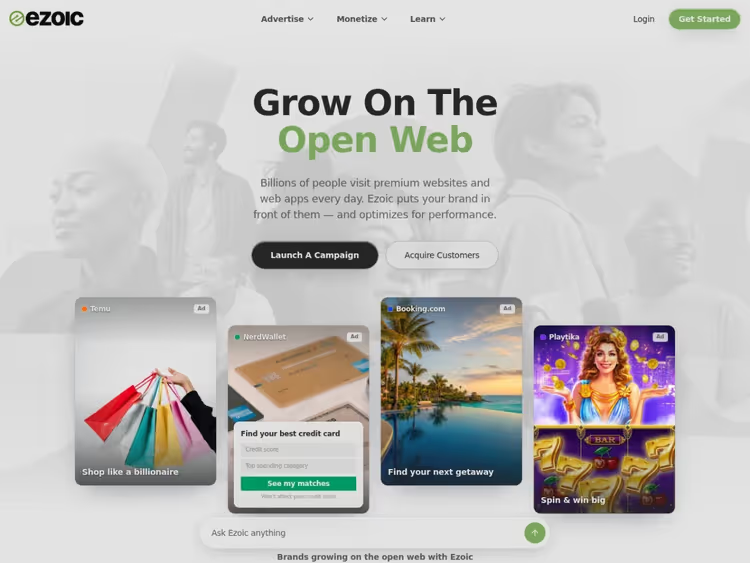
The practical takeaway for a mid-sized site owner sounds unpleasant but honest: if you're not reaching a six-figure audience and aren't ready to prove growth, you can cross Ezoic off your list of candidates right away. But for sites that have already passed that scale, the first-party data argument has become more compelling than the classic conversation about rates.
Mediavine: entry through revenue, not pageviews
Mediavine took a third path and effectively stopped measuring newcomers by traffic. On the Mediavine requirements page, the main tier is described through revenue: a site needs to generate at least 5,000 dollars in ad revenue per year. Those who haven't reached that mark are offered Journey, an entry-level tier with a threshold of 1,000 sessions. A detailed breakdown of Journey clarifies that the updated rules took effect on January 15, 2026, and the transition to the main tier happens automatically once a site reaches the required annual revenue.
The metric change looks like a small detail, but it rewrites the strategy. Previously, a blogger chased sessions and could hit a wall with traffic that monetizes poorly. Now the system itself pulls in those whose audience generates money, even if the site is modest in volume. A niche blog about finance or real estate with a small but high-value audience gets through faster than an entertainment project with several times more visits.

This leads to a non-obvious tactic: instead of chasing total visit volume, it makes sense to strengthen the sections with higher commercial intent. One well-ranking review in an expensive ad vertical can move annual revenue more noticeably than a dozen lightweight articles with high traffic and low rates.
Raptive: an open door with a geography caveat
Raptive removed its main barrier and became more accessible, but not for everyone. The breakdown from Search Engine Journal notes a 75 percent reduction in the requirement, down to 25,000 pageviews. The condition is offset by geography: as PPC Land's piece on the new rules points out, sites with traffic between 25,000 and 99,999 pageviews need half of their audience to come from the US, UK, Canada, Australia, or New Zealand, while larger sites only need a 40 percent share.
The logic is transparent. Advertisers pay for specific markets, and the network is willing to lower the quantitative threshold if audience quality makes up the difference. Raptive's own blog post about expanding access describes the change specifically as a bet on quality standards rather than volume. The intermediate Rise program also disappeared, and all publishers are now served under a single tier.
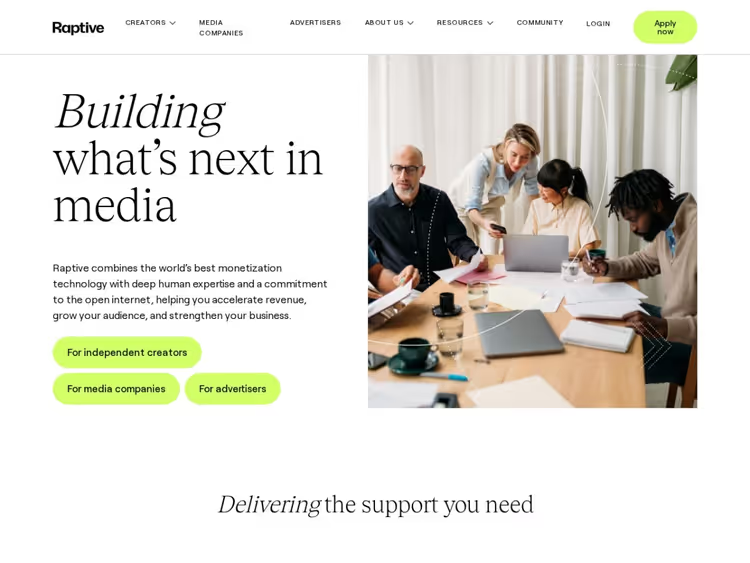
For Russian-language projects, this is a key fork in the road. A site with excellent traffic from the CIS may formally clear the pageview threshold and still get rejected because the geography doesn't hold up. Conversely, a small English-language blog with a US audience passes easily.
Money: share, payment terms, and what average figures hide
Payment terms matter more than advertising promises. According to the same PPC Land review, Raptive leaves the publisher 75 percent of ad revenue, keeping a quarter for ad serving, support, and technology, and payouts follow a Net 45 schedule: payment on the 15th for the month closed 45 days earlier. The same source cites a corporate figure of a 75 percent average revenue increase when switching from other major providers, and that number deserves a healthy dose of skepticism.
What to compare | Why it matters more than RPM | Common mistake |
|---|---|---|
Publisher share | determines income at identical rates | looking only at the promised RPM |
Payment schedule | creates a two-month cash gap | assuming money arrives at the end of the month |
Ad density | affects bounce rate and pages per session | comparing networks with different ad loads |
Page speed | a slowdown hurts search traffic | running a test without measuring Core Web Vitals |
Test seasonality | advertiser demand fluctuates month to month | comparing December with January |
The average uplift from migration is almost always overstated for your specific case for a simple reason: the statistics mostly include publishers who left genuinely weak monetization. If you already have a properly configured network and reasonable ad density, a realistic expectation is moderate growth, not a doubling.
Case study: moving a travel blog to Journey
A good example of public observation is described in a report on the first three months with Journey: a travel blog author documents the move to Mediavine's entry tier and shows month-by-month revenue dynamics without smoothing over weak weeks. The value of that material is not in the specific dollar amount, but in the visible seasonality effect and the fact that the first month turned out to be unrepresentative.
This scenario repeats for most publishers. In the first weeks after onboarding, the network adjusts ad placement configurations, rates jump around, and there is almost no data to draw conclusions from. A decision to migrate the entire site made in the second week of testing is statistically groundless.

It is also worth tracking not just revenue, but audience behavior: pages per session, time on page, and return rate. If ad load increased while engagement dropped, part of the revenue gain will come back as lost search traffic a few months later.
What comparison tables leave out
Three things regularly decide the outcome but almost never appear in comparisons. First: support. Response speed and willingness to dig into a specific site configuration vary more between networks than rates do, and this is especially noticeable in the first month, when something inevitably breaks.
Second: control over ad density. Automatic optimization can boost revenue with aggressive formats that annoy readers. If you run a blog with a loyal audience rather than a stream of random search visitors, it is worth manually limiting the most intrusive placements.
Third: reversibility of the decision. Leaving a network is rarely instant, and recovering previous metrics after a failed experiment takes weeks. That is why testing on one section of the site is cheaper than a full migration, even if it looks slower.
⁉️🤔 Frequently asked questions
Can a small blog get into Ezoic now?
Not through the standard path, because new publishers face a threshold of a quarter million users per month. The remaining option is the Incubator program with a limited number of monthly participants, where projects with convincing growth trajectories are accepted. An application should be backed by six months of traffic charts, not vague statements about future plans.
Which is better for a niche blog: Mediavine or Raptive?
The answer depends on audience geography. Raptive requires a high share of traffic from English-speaking markets, so a project with a CIS-based audience usually does not qualify. Mediavine evaluates newcomers by revenue and has an entry tier with a low session threshold, which makes it more realistic for niche sites with modest visit volumes.
How long until the first payout after onboarding?
Plan for roughly a two-month cash gap. Raptive's Net 45 schedule means a mid-month transfer for the period closed 45 days earlier. Other networks have different timelines, but the principle is similar, so you should definitely not count on a payout at the end of the first month.
Is it true that moving to a premium network doubles revenue?
Corporate figures on average revenue growth are mostly collected from publishers who left weak monetization setups. If you already have a working configuration and reasonable ad density, expect moderate growth. The honest way to test this for your case is a trial on part of the site with a full calendar month of data.
How do I avoid losing search traffic when switching networks?
Measure Core Web Vitals before onboarding and two weeks after. Ad scripts affect rendering and layout stability, and a drop in these metrics shows up in rankings with a delay. If the numbers worsen, reduce ad density until previous values are restored, even at the cost of some revenue.
Is it worth running multiple networks at the same time?
On a single site this is rarely justified: networks compete for the same impressions and interfere with each other's optimization. However, distributing different projects across different networks makes good sense, especially when the sites have different audience geographies or topics with different ad pricing.
Bottom line: how to decide without guessing
The 2026 market does not work the way guides from two years ago described. Ezoic has become a network for large sites, Mediavine evaluates newcomers by revenue rather than visits, and Raptive has opened the door to small sites but demands the right audience geography in return. So the first thing to look at is not the promised RPM, but which door you can actually walk through.
After that, a simple algorithm applies: filter out networks by formal criteria, compare publisher share and payment terms, check the impact on site speed, and make sure to test on part of the project for at least one full month. This approach takes more time than picking from someone else's ranking, but it saves you from a migration you would have to roll back.
Start with the cheapest step: open your analytics and write down three numbers for the last 30 days, namely sessions, pageviews, and the share of English-language traffic. That is enough to narrow the list of candidates down to one or two realistic options in a single evening and stop comparing yourself to case studies that have nothing to do with your site.

A professional team of writers and editors specializing in creating quality content.