


🌌 Creating parallel worlds in fantasy: a complete guide
Where a parallel world begins
Building a parallel world in fantasy rests not on dragons and magic as such, but on an internal logic the reader accepts without reservation. A strong world works like clockwork. Geography shapes trade, trade gives rise to cities, cities produce politics, and politics spills into conflict that drives the plot. If you are writing a book and want the universe to hold up on its own, start with rules, not decoration.
Over fifteen years of working with author manuscripts, I have noticed one pattern. Texts where the world is thought through down to the laws of nature and economics read more easily and fall apart less often by the ending. Shallow settings, by contrast, start contradicting themselves by the middle of the book, and the author spends weeks patching holes.
Demand for well-developed worlds is at a record high right now. According to Circana BookScan, romantasy and fantasy led the growth of adult print fiction in the US in the first quarter of 2025, and individual titles like Rebecca Yarros's "Onyx Storm" sold nearly 1.7 million copies in a year. The takeaway is simple: readers are willing to invest in thought-out universes, and the quality bar is rising.
💡 Quick overview: to build a convincing parallel world, work through five steps in order. Each one builds on the previous one.
- Establish the rules of physics and magic: what is possible in the world and what is not, and at what cost.
- Draw a map: geography dictates climate, resources, and where peoples settle.
- Write the history and chronology: the past explains current conflicts.
- Create cultures: traditions, languages, and beliefs make the world feel alive.
- Tie everything to the plot: the world should serve the story, not the other way around.
Rules of magic: why limits matter more than power
The main mistake beginning authors make is giving their characters unlimited magic. Without clear limits, tension disappears: if a wizard can do anything, the reader stops worrying about the outcome. Brandon Sanderson, author of the Stormlight Archive series, put this into his first law. An author's ability to resolve conflicts with magic is directly proportional to how well the reader understands its rules.
A magic system does not have to be complex, but it does have to be consistent. Define three things: the source of power, its cost, and its boundaries. A fire mage who physically burns out after a major spell is more interesting than an all-powerful sorcerer, because his power has a price. It is precisely the limits that turn magic from a "god from the machine" device into a full-fledged plot tool.
System element | Weak development | Strong development |
|---|---|---|
Source of power | "magic just exists" | a specific resource (metal, blood, stars) |
Cost | no consequences | fatigue, risk, moral choice |
Boundaries | the hero can do anything | clear limits and exceptions |
Connection to the world | magic in a vacuum | affects the economy and politics |
A useful exercise: ask yourself how your magic changes everyday life. If a healing spell exists, why does this world need doctors? If mages can summon rain, how does that affect agriculture and power? Answers to such mundane questions make a system credible far more than flashy battle scenes do.
World map: geography gives rise to plot
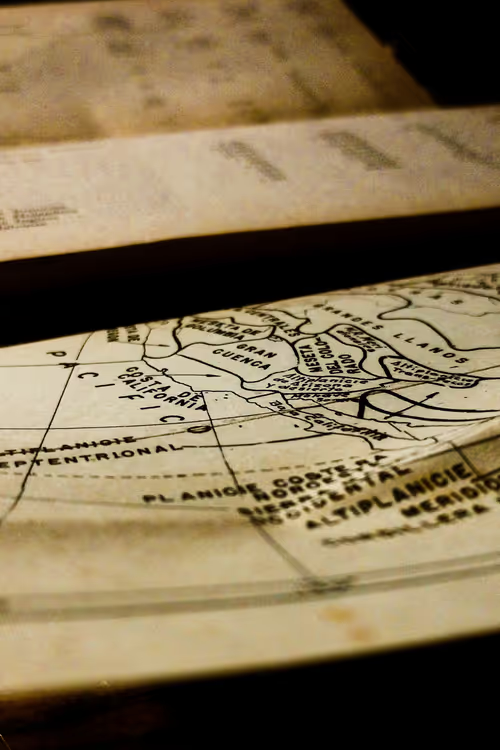
According to Wikipedia, creating a map is considered one of the first tasks of any worldbuilding effort. A map establishes the terrain and the placement of civilizations, and helps both the author and the reader orient themselves in space. Physical geography, meaning mountain ranges, rivers, and climate zones, determines where cities will arise, how trade routes will run, and why two peoples will clash over a mountain pass or a river mouth.
You do not need to be an artist to design a map. It is enough to answer a few questions: where are the sources of fresh water, which regions are fertile, what separates cultures (mountains, sea, or desert). After that, logic does the work for you. A coastal people will become mercantile and open, a mountain people will turn out insular and warlike, and a people in a fertile valley will become a tempting target for conquerors.
The team at Reedsy, an editorial platform for authors, advises against overloading the map with details at the start. First place the large features, such as continents, seas, and mountain ranges, and only then break them down into kingdoms and cities as the plot demands new locations.
History and chronology: depth the reader can feel
The reader rarely sees the entire history of a world, but always senses its absence. A worked-out chronology of wars, dynasties, disasters, and inventions creates the very depth that keeps people coming back to Tolkien and Martin. J. R. R. Tolkien, creator of Middle-earth, devised ages and languages long before he sat down to write The Lord of the Rings, and that invisible work shines through in every chapter.
Put together a chronology of key events: how the states came into being, which wars redrew the map, where the current alliances and grievances came from. You do not need to show all of this directly. It is enough for characters to refer to the past naturally, exactly the way we refer to historical events in our own world. Then the current conflict gains roots instead of hanging in the air.
"Fantasy is not limited to magic and dragons. It is the art of creating entire worlds with their own history, culture, and living characters."

Culture and peoples: what makes a world feel alive
A world without culture remains an empty backdrop. Traditions, holidays, cuisine, taboos, attitudes toward death and the gods: these are the details that make a reader believe a people existed long before the book began. According to Wikipedia, constructed cultures usually draw inspiration from real human civilizations, so the fictional world stays understandable while remaining alien and new.
A useful technique is to give each people one central question. What does it fear? What does it revere? How does it make a living? The answers ripple outward into everything else: architecture, clothing, forms of politeness. A people that survived centuries of drought will treat water with religious awe, and that will show up in its proverbs, rituals, and even in how people greet one another.
Language and names
You do not need to invent a full language, as Tolkien did. It is enough to set phonetic rules, meaning you decide which sounds are typical for each people, so that names within one culture sound related. This subconsciously signals to the reader that the characters belong to the same world. Keep a short list of syllables for each people, and new names will assemble themselves while staying recognizable.
Video breakdown: how professionals build worlds
One of the best open resources on the topic is Brandon Sanderson's lecture from his writing craft course at Brigham Young University. He breaks down in detail how geography and history influence culture and how to avoid common worldbuilding mistakes.
Real case: how the market for developed universes is growing
To understand how much worldbuilding work pays off, look at the numbers. The global fantasy book market is estimated at roughly $17.97 billion in 2025, with a forecast of growth to $26.01 billion by 2033 at a compound annual rate of 4.7%, according to Global Growth Insights. At the same time, US fantasy volume in units fell 8.7% to 24.1 million copies in 2025, according to Circana BookScan. That means the market is shifting toward hybrid genres.
The main such hybrid is called romantasy. According to the same Circana data, romantasy and sports romance showed triple-digit growth in 2025, and the total romance segment exceeded 51 million copies sold over twelve months. The takeaway for an author is simple: the market rewards not the genre itself, but the depth of the work. Worlds readers want to return to sell steadily, while shallow titles live for one viral cycle and are forgotten.
Examples of successful universes
The best worlds became benchmarks for a reason. Each of them has an internal logic that holds up under scrutiny.
- Middle-earth: the world of J. R. R. Tolkien with detailed races, languages, and a thousand-year history laid down long before the plot of the books.
- Westeros: the world of "Game of Thrones" by George R. R. Martin, where politics and geography matter more than magic, and every conflict is rooted in the history of dynasties.
- Roshar: the world of "The Stormlight Archive" by Brandon Sanderson, built on a strict magic system and unique ecology, where even the flora adapted to devastating storms.
These universes have one thing in common: the author knew ten times more about them than they showed on the page. That hidden depth is what creates the feeling that the world keeps living after we close the book.
⁉️🤔 Common questions about building parallel worlds
Where should a beginner start when building a fantasy world?
Start with rules, not with a map. Define what is possible in your world and what is not: does magic work, what is its cost, which laws of nature differ from ours. These boundaries set the tone for everything else, from geography to cultures and conflicts. The scenery comes last.
Do I need to invent an entire language, like Tolkien did?
No, a full language is not required and takes years of work. It is enough to establish phonetic rules so that names within one culture sound related. This gives the reader a sense of a cohesive world without a huge investment of time in linguistics and grammar.
How much world history should I write before starting the book?
Exactly enough for you to understand the roots of the current conflicts yourself. The reader should not see the entire chronology, they should only feel that it exists. Write out the key wars, dynasties, and catastrophes, and add details as the plot requires.
How do I make a magic system interesting?
Give it a cost and limits. Unlimited magic kills tension because it removes risk. Define the source of power, its price for the hero, and clear boundaries. It is the limitations that turn magic into a plot tool rather than a way to solve any problem with a snap of the fingers.
Does the work on a detailed universe pay off?
Yes, the market rewards depth. According to Circana, well-developed fantasy and romantasy showed triple-digit sales growth in 2025, while shallow titles live for one viral cycle. Readers return to worlds they believe in and recommend them to others.
Conclusion
Building a parallel world is the engineering of imagination. First rules, then the map, then history and cultures, and only at the end the plot that ties it all together. This order guarantees that your universe will stand on its own, and the reader will believe in it without a single caveat. Start with one rule and one question about one people, and the world will begin to grow on its own.
Ready to turn your universe into a published book? Move your parallel world forward by choosing this publishing marketplace.

A professional team of writers and editors specializing in creating quality content.