



🎁 Gift books: how an indie author can create an edition people buy as a gift
A gift book lives by different rules than a regular print run: it is chosen not for yourself but for another person, and the decision is made in two minutes at the shelf or on a product page. Let's break down what goes into such an edition, how to time its release to the season, and which channels bring revenue beyond the major platforms, and if promotion needs to be taken outside, a platform for guest posts comes in handy, where authors find niche blogs.
How to put together a gift edition in one season
💡 Quick overview:
- Step 1: pick the occasion (winter holidays, graduation, wedding season, professional day) and lock in the date by which the book must physically be in the warehouse.
- Step 2: count back at least four months and map out the slots: editing, layout, cover, proof copy, file upload.
- Step 3: define the gift format (hardcover, larger type, illustrations, endpapers, ribbon bookmark) and build it into the budget before layout starts.
- Step 4: order a physical proof and hold it in your hands, the screen distorts both color and block thickness.
- Step 5: prepare the product page so the first photo reads as a gift, not as an ordinary cover.
- Step 6: book paid placements and newsletter slots in advance, during peak season slots disappear weeks ahead.
- Step 7: after the holidays, collect channel statistics and decide what you repeat in the next cycle.
Why a book remains the default gift
A book closes three needs of the giver at once: it fits almost any relationship, it cannot be ruined by the wrong size, and it does not look like a lazy choice. At the same time, the print market has not collapsed, as was expected about ten years ago. According to the Publishers Weekly annual report on print sales, 762.4 million print copies were sold in the US in 2025, up 0.3% from 2024, and that is the second consecutive year of growth.
Even more important is the interim picture. The nine-month interim report for 2025 recorded a 0.9% decline in print sales compared to the same period of the previous year. That means the entire annual gain was concentrated in the last quarter. For an author, this is not abstract statistics but a direct instruction: if your print run arrives in January, you missed exactly the period that carries the year.
It is also useful to look at the composition of demand. The same category breakdown for 2025 shows that romance fiction grew by 3.9% and nearly reached 44 million copies, while graphic novels added 9.2% and delivered 25.9 million. Both categories are strong precisely in the gift scenario: they are pleasant to hold, there is no embarrassment in giving them, and they look good in a photo. If you write in an adjacent field, you already have half the argument for a gift edition.
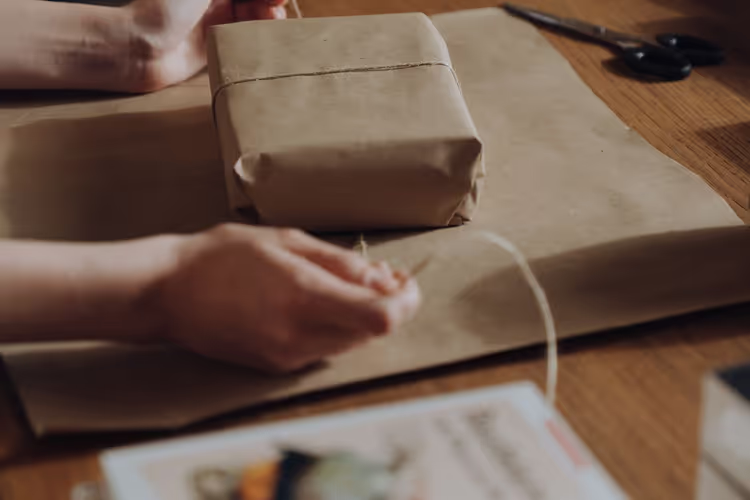
What sets a gift print run apart from a regular one
The difference is almost never in the text. It is in the decisions made at the production stage, decisions that cannot be rolled back after files are uploaded.
First: the binding. A hardcover changes price perception more than any blurb. A special hardcover edition reads as a collectible item, which is why its release is usually timed for autumn, when buyers start looking for meaningful gifts. An autumn launch gives you room for a reprint if demand exceeds expectations.
Second: paper and margins. A gift book is read more slowly, so increased line spacing and heavier paper work to create a sense of value. Cutting corners here is noticeable to the touch, and it is noticeable precisely to the person giving the book.
Third: personalization. A signature, a numbered copy, an inserted card, a separate endpaper for a dedication. This is something traditional publishers almost never offer, and an indie author does without any approvals. Flexibility in design and packaging has long been considered the main structural advantage of self-publishing, and in the gift segment it fully comes into its own, because the buyer is paying precisely for the uniqueness of the object.
Fourth: the unit of sale. A two-book set, a book with a bookmark, a book with a poster. A set raises the average order value without new text and at the same time removes the giver's worry that the gift might look too modest.
The economics of the gift format
A hardcover costs more to print, but it also sells for more, and on paper that looks more convincing than in arguments. How print-on-demand hardcover works is covered in detail in the Amazon KDP hardcover launch review: a printed cover without a dust jacket is available, and the royalty rate is tied to the retail price.
Parameter | Paperback | Hardcover |
|---|---|---|
Role in the catalog | base print run, reading for yourself | gift, collection, shelf |
Price perception | compared with an e-book | compared with a keepsake |
Demand seasonality | steady throughout the year | peak in the last quarter |
What drives the sale | reviews and price | the look of the first photo |
Main risk | low | higher cost per copy |
The table should be read like this: a hardcover does not replace a paperback, it builds on top of it. A catalog that has both formats catches both the person buying for themselves and the person choosing a gift, and the latter barely looks at a competitor's price.
A separate expense line that indie authors consistently underestimate is product photography. A gift book is sold not by the blurb, but by a shot where it lies next to a ribbon and wrapping. One good shooting day covers the need for several seasons.
A calendar that decides more than the text
Seasonal revenue is not about luck, it is about dates. There are three anchor points around which the plan is built.
Point one: production. Print on demand removes the inventory question, but it does not remove the question of vendor queues. A cover designer and a proofreader are busy in October, and that is predictable.
Point two: the storefront. The product page needs to be filled before seasonal traffic starts, otherwise the buyer will arrive at an empty page with no reviews and no photos.
Point three: launch push. Paid placements, themed newsletters, guest posts with adjacent authors. The same rule applies here as in production: slots are finite.

It is useful to keep a yearly calendar of occasions on hand, and not only the well-known ones. Professional days, local holidays, round anniversaries of historical events, themed months. A niche occasion brings less traffic, but competition there is almost zero, and a book on a narrow topic given as a gift reads as a sign of attention rather than an accidental purchase.
Channels indie authors avoid
A large marketplace is convenient, but gift demand does not live only there. Independent bookstores are happy to take local authors for the season, especially if the edition looks attractive and the author has an audience in the city. Museum and themed shops buy books that match their profile, and there the gift format is almost mandatory.
Corporate gifts are a separate story. Companies look every year for something to give employees and partners, and a book with meaningful content beats yet another set of dishes. Such deals go in batches of several dozen copies and require no advertising budget, just a targeted email.
Direct sales from your own site give the highest margin and, more importantly, the buyer's contact. A gift giver who bought directly from you will come back a year later for the next gift, if you remind them about yourself.
Finally, partnership logic works: exchanging mentions with authors in adjacent genres, joint bundles, guest material on other people's blogs. Audiences overlap, and the budget stays at zero.
Case study: a special edition as a separate product
2025 provided a telling example. According to Publishers Weekly sales leaders data, the collector's edition of Rebecca Yarros's novel sold nearly 1.7 million copies over the year. This is not a new text, but a repackaging of an existing one: different design, an expanded visual layer, the status of an object you want to display prominently.
The mechanics work at any scale. You have a novel that came out three years ago and has long since slid to the back of the catalog. An anniversary edition with a new foreword, illustrated section dividers, and a hardcover becomes a standalone product: it is bought by those who have already read the book and by those choosing a gift for someone who has.
A similar logic is confirmed by the demand structure in nonfiction. The nonfiction category report shows that while the segment overall declined by 1.5% in 2025, self-help literature grew by 14.7%, and religious books grew by 5.4%, approaching 67 million copies. Both niches are traditionally strong in the gifting scenario: such books are given with intention, not as an afterthought.

Market context is best checked against more than one source. Quarterly and genre analytics are published by industry observers, for example the quarterly print sales breakdown, while summaries of seasonal print surges appear in specialized book trade publications. A useful plain-language analysis of annual figures is regularly provided by an independent book market analyst.
⁉️🤔 Frequently asked questions
Do I need to write a new book to enter the gifting segment?
No. More often it is more profitable to repackage an already published text: hardcover, new foreword, illustrated section dividers, numbered copies. This gives you a separate product without a writing cycle, while existing reviews and accumulated search traffic keep working for the product page. Writing a new text makes sense when the occasion has no suitable material in your catalog.
How many months in advance should I start preparing?
Plan for at least four months before the date when the book must be available for ordering. That is enough for editing, layout, cover design, a physical proof, and re-uploading files after corrections. Separately, allow time for booking paid placements: during the high season, slots are taken weeks before the launch.
Is hardcover always more profitable than paperback?
Not always, but it solves a different problem. The per-unit cost is higher, but so is the acceptable retail price, and a gift buyer compares the book not with the digital version, but with other gifts in the same price range. The optimal approach is to keep both formats: paperback serves readers buying for themselves, hardcover serves gift givers.
What if my genre has no connection to holidays?
The occasion does not have to be calendar-based. Graduation, housewarming, a professional day, an anniversary, a first job. A short story featuring familiar characters or supplementary material in the form of a booklet turns any genre into a gift, because what is being given is not a topic, but attention to the recipient.
How do I sell a gift book without an advertising budget?
Through channels where a person, not an algorithm, makes the decision: independent bookstores in your city, themed and museum shops, corporate purchases, direct sales from your own website, joint bundles with authors in adjacent genres, and guest posts on other people's blogs. These channels are slower, but they do not require paying for impressions.
Summary
A gift book does not require new talent from an author; it requires different planning. The format is decided before layout, the date is decided before printing, and the channels are booked before the season. Everything else you already know how to do.
If you want to test the approach in practice, pick one occasion in the next six months, count back four months, and put three dates on your calendar: file delivery, proof receipt, promotion launch. Then follow the checklist from the first section and check your decisions against the book market materials collected in the links above. One carefully executed season usually delivers more than a year of unsystematic publishing.

A professional team of writers and editors specializing in creating quality content.