


 AIIllustrative image: AI-generated
📱 Writer on social media: promotion strategies
Social media has long stopped being just a place for memes and cat videos. For a writer, it is a direct channel to readers that does not depend on publishing budgets, bookstore shelves, or the whims of marketplace algorithms. The question is not whether an author should be on social media, but how to do it without burnout and with measurable returns. According to a BookBub survey of 850 authors, 78% of writers use at least one platform weekly, and 79% name finding new readers as their main goal. At the same time, only half of authors create video content, and that is exactly where the biggest growth opportunity lies for the coming years.
💡 Quick overview:
- Step 1: Pick one or two platforms where your audience actually spends time, and completely ignore the rest
- Step 2: Build a content plan with the right mix (valuable content, reposts, occasional promo) and publish consistently
- Step 3: Launch an email newsletter through social media as your main asset, one the algorithms cannot take away
- Step 4: Master one video format (short clips or long-form deep dives) and move followers to owned channels
📱 Where readers live: platforms without illusions
Platform choice determines 80% of the outcome. Agents and publishers look not at follower counts, but at engagement within a specific genre community. BookBub survey data for 2025 shows a clear genre breakdown:
Platform | Core audience | Leading genres | Main author tool |
|---|---|---|---|
25-44 | Women's Fiction, Romance, Christian Fiction | #bookstagram, visual roundups, Reels | |
TikTok | under 35 | Teen & YA, Romance, Thrillers | #BookTok, emotional reviews, trends |
35+ | Women's Fiction, Religion, Christian Fiction | Interest groups, live conversation | |
Bluesky | All ages | Sci-Fi, Horror, Literary Fiction | Text discussions, industry connections |
YouTube | 25-44 | Literary Fiction, Religion, Middle Grade | In-depth reviews, writing vlogs |
Instagram and Facebook hold the lead: 62% of authors use Facebook weekly, 51% use Instagram. Meanwhile, Bluesky is growing at 8% per year, with science fiction and horror authors actively migrating from platform X.

The main trap for a new author is wanting to be everywhere. The ManuscriptReport 2026 guide puts it bluntly: pick one or two platforms and build real depth there. A writer who posts once a month across five social networks is invisible everywhere. A writer who shows up three times a week on Instagram Reels with behind-the-scenes of working on a novel builds a core of two hundred active readers within six months.
✍️ Content that does not scream "buy my book"
The 70-20-10 rule, popularized by SocialBee in a report on 9.3 million posts for 2025, works flawlessly for authors. 70% content that is useful or engaging (behind the scenes of writing, breakdowns of plot techniques, character aesthetics). 20% curated content: reposts from colleagues, book recommendations, participating in community events. And only 10% direct book promotion.
Authors who switched to this model note in a BookBub survey that the key metric becomes not reach, but conversion to newsletter subscribers. The email list is the only asset that does not depend on account bans or algorithm changes. Every social media post should gently nudge toward subscribing. A practical tactic: at the end of every third post, add the line "once a week I send a draft chapter and a roundup of book finds, subscribe via the link in my profile bio." Authors who implemented this mechanic in 2025, according to internal Metricool data, averaged ten to fifteen new newsletter subscribers per thousand post views, which is an order of magnitude cheaper than paid advertising.
A real case: a romantic fantasy author from Kansas built a TikTok → Instagram → newsletter → preorder funnel in 2025. Her TikTok account grew from 400 to 11,000 followers thanks to short videos of "what scene I'm writing today," each ending with a link in bio to a free chapter. Preorders for the second book in the series exceeded the first by three times, and Metricool data across 21 million posts confirms that behind-the-scenes creative process videos consistently deliver an engagement rate 2 to 2.5 times higher than any promo posts.
🎬 Video for writers: scary, but mandatory
According to Social Media Examiner data for 2026, video content remains the fastest-growing format for organic reach. At the same time, a BookBub survey captures a paradox: more than half of authors do not create video at all. The main reason: "it takes too long, and I would rather write a chapter."

Meanwhile, the gap between authors who started publishing before 2010 and those who debuted after 2020 is enormous. According to BookBub data, among "legacy" authors only 9% use TikTok regularly, and 13% use YouTube. Among post-2020 debut authors the picture is reversed: 18% on TikTok and 7% on YouTube. An author entering the industry today loses half of the available audience without video.
From my own experience I can say: the first two videos will be awkward, and that is normal. The practical minimum for 2026: one video format that requires no editing. A smartphone on a tripod, 60 seconds of talking about today's scene, character, or plot dilemma, and publishing without any post-processing. According to Metricool's internal analytics for 2025, such videos hold retention better than polished videos with graphics, because the reader senses a real person, not a marketing department.
A separate piece of advice concerns tools: do not buy a professional camera and editing software at the start. A modern mid-range smartphone shoots video that looks flawless on a phone screen. The CapCut app or the phone's built-in editor covers the basic needs: trim pauses, add subtitles (a must, most people watch without sound), overlay a text headline in the first three seconds. Social Media Examiner emphasizes in its 2026 report: authors who publish videos with subtitles get on average a quarter more full views than those who post videos without text support. Subtitles also work for inclusivity: people with hearing impairments and those scrolling the feed on public transit without headphones equally get the full meaning of the video through text.
📚 Community instead of audience
The main shift of 2025-2026, from passive content consumption to participation. SocialInsider in its 2026 benchmarks notes: posts that initiate discussion (questions, polls, "what do you think about...") get three times more comments than informational updates. For an author this means a specific tactic: end every third post with an open question to the reader.
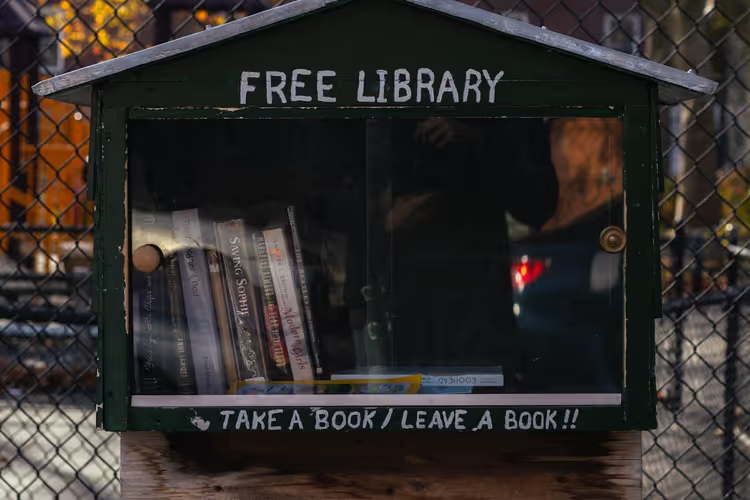
Authors who build communities around books rather than around their own name get more sustainable results. The ManuscriptReport 2026 guide advises creating a Facebook group not called "fans of Ivan Petrov" but "lovers of urban fantasy with a detective storyline." In such a group, readers discuss the genre, recommend books to each other, and your book becomes part of an organic conversation rather than an interrupting ad.
The Social Media Examiner figures for 2026 confirm the trend: 73% of marketers named community building their number one priority for 2026, ahead of direct sales (61%) and even brand awareness (68%). A writer acting as a solo marketer should treat these proportions as a baseline. A practical benchmark: one Facebook group with two hundred active members produces more predictable sales for a new release than three thousand passive Instagram followers. SocialInsider research confirms that group posts consistently earn a higher engagement rate than brand pages, because the Facebook algorithm prioritizes content from groups where the user is already active.
⁉️🤔 Frequently asked questions
Does a writer need to be on all social networks at once?
No, and trying to be everywhere is the main cause of burnout. According to ManuscriptReport data, one or two platforms with regular content are enough. Pick the one where your genre's audience is already active: Instagram for romance and visual genres, TikTok for young adult and thrillers, Facebook for historical fiction and nonfiction, Bluesky for science fiction.
How much time per week should you realistically spend on social media to see results?
According to a BookBub survey of 850 authors, more than 90% of writers spend at least a few hours a month creating content. The productive minimum for 2026 is three posts per week on one platform plus one video format. That adds up to roughly three to four hours a week including filming. Anything beyond that only makes sense if you delegate or hire an assistant.
Should a debut author pay for social media ads?
For a debut author, no. Social Media Examiner's 2026 report notes that organic reach for micro-bloggers (under 1,000 followers) still works: TikTok and Instagram Reels algorithms actively show new content to unfamiliar audiences. Paid promotion makes sense when you launch a preorder or a box set and already have a base of 500+ people who will provide social proof under the ad.
What type of content works best for selling books?
Not a direct promo post, but reader proof. According to Metricool's internal 2025 data, reposts of reader reviews and book unboxing videos deliver on average one and a half to two times higher link-click conversion than author announcements. The best ad for a book is someone else's excitement about it.
How do you know a platform is "not for you," and when is it time to leave?
The criterion is simple: after three months of regular posting (three times a week), if you have fewer than a hundred active followers and zero substantive comments from people you don't know, the platform is either not for you or you've chosen the wrong format. SocialInsider's 2026 research shows that healthy organic growth for a new author page is fifty to two hundred followers per month, provided you post consistently and pick the right niche.
Can you promote a book without any video at all?
You can, but you're deliberately cutting off the under-35 audience and reducing your potential reach by at least half. According to SocialBee's 2025 data, video formats generate the highest organic reach of all content types on four out of five major platforms. If video is absolutely not your thing, focus on text-based platforms (Bluesky, Substack) and your email newsletter as your core asset.
🏁 Bottom line: a platform for the year ahead
Social media for writers in 2026 is not about likes. It's about building an asset that converts a stranger into a newsletter subscriber, and a subscriber into a book buyer. The key steps that pay off within six months: picking one platform that fits your genre, a 70-20-10 content plan, one regular video format, and a funnel to your email list. BookBub's survey of 850 authors confirms it: 79% of writers already use social media to find new readers, and the competition is growing. Start with one Reel or one post today, and in six months you won't recognize your reader base. Algorithms come and go, platforms rise and fall, but the direct reader-to-author relationship remains the only currency that never loses value.

A professional team of writers and editors specializing in creating quality content.